
Homework can feel like a heavy bag at the end of a long school day. You may sit at your desk for an hour but finish only one small task. A message on the phone, a missing notebook, or one difficult maths question can break your focus.
The good news is that you do not need to rush, copy answers, or work late into the night. You need a clear order, a quiet place, and a few simple habits. This guide explains how to finish homework faster while still understanding what you learn. Students can follow the steps on their own, and parents can use the short support plan near the end.
Why Does Homework Take So Long?
Homework often takes longer because of small delays, not because the work is impossible. A student may start without knowing every task, look for books many times, check the phone, or spend too long making one answer perfect. Tiredness and hunger can also make the mind slow.
Before trying to work faster, find the real problem. Ask yourself:
- Do I know all the homework given today?
- Do I have the books and tools I need?
- Is my phone or television taking my attention?
- Am I stuck because I did not understand the lesson?
- Am I tired, thirsty, or hungry?
Your answer tells you what to fix first. Working faster does not mean writing carelessly. It means removing wasted time and giving full attention to one task.
A Quick 45-Minute Homework Plan
Use this plan on a normal school day. Change the time if your work is shorter or longer.
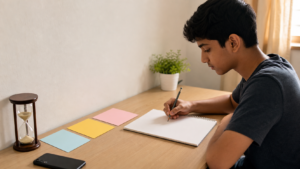
- 5 minutes: Make a list. Check your school diary, class group, and notebooks. Write every task on one page.
- 20 minutes: Do one focused task. Start with an important subject and keep only its book on the desk.
- 5 minutes: Take a break. Stand up, drink water, and rest your eyes. Do not open a game or short-video app.
- 15 minutes: Finish the next task. Continue with the same focus.
After 45 minutes, check your list. If work remains, take another short break and repeat. A timer helps you notice time, but it should not make you nervous.
15 Simple Ways to Finish Homework Faster
1. Write Every Task in One Homework List
Do not try to remember homework in your head. Write the subject, task, and due date in one list. For example: “Maths: questions 1–10, tomorrow” is clearer than “do maths.” Put a small box beside each task and tick it when complete. This gives your brain one clear map.
2. Prepare Your Desk Before You Begin
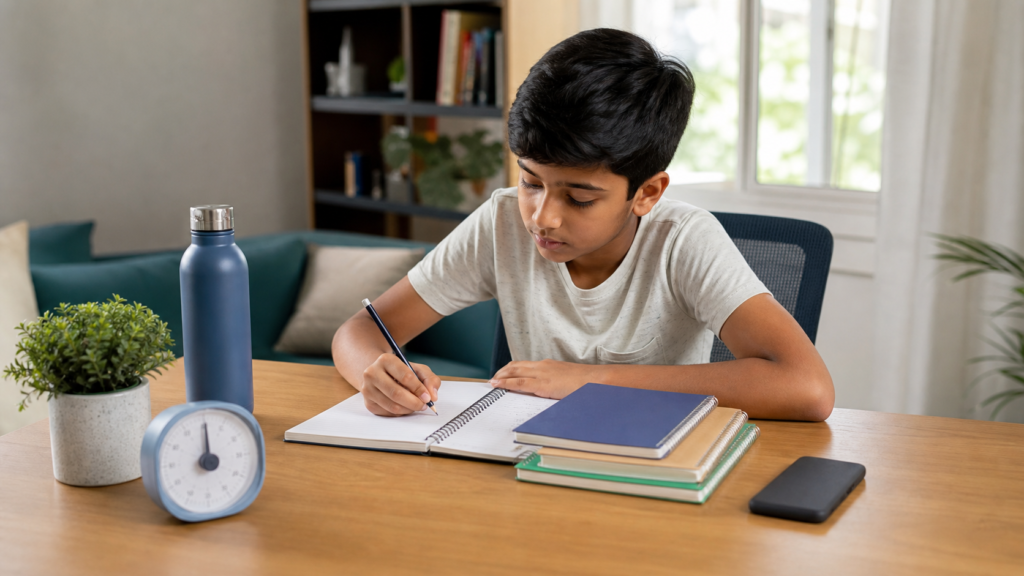
Collect notebooks, textbooks, pencils, an eraser, a ruler, and water before starting. Keep only the items needed for the current subject on the desk. A two-minute setup can prevent ten minutes of searching later.
3. Keep the Phone Outside Your Reach
A phone can break your focus even when you do not touch it. Put it in another room or give it to a parent for the study period. If you need it for a school message or learning video, open only that item and close it when the task is done. Turn off alerts.
4. Choose the Right Subject Order
There is no single best order for everyone. If you have good energy, begin with the hardest or most urgent task. If starting feels difficult, complete one short task first and use that success to build speed. Do not always leave the hardest work for bedtime.
5. Work on One Subject at a Time
Switching between English, science, and maths wastes time because your mind must adjust again and again. Finish a clear part of one subject before opening another. One book, one notebook, and one goal should be on the desk.
6. Use a Short Focus Timer
Set a timer for 20 or 25 minutes. During that time, work only on the chosen task. When the timer ends, take a three-to-five-minute break. Younger students may prefer 15-minute focus blocks. The aim is steady attention, not racing.
7. Read the Question Twice
Many students lose time because they begin before understanding the instruction. Read the question once for meaning and once for details. Circle words such as “explain,” “compare,” “draw,” or “give two examples.” A correct start is faster than rewriting a wrong answer.
8. Break Large Work into Tiny Steps
“Complete science project” feels huge. Change it into smaller steps: choose the topic, collect facts, make headings, write the first section, add pictures, and check the file. Complete one step at a time. For more help, read SHEAT Public School’s guide on how to make a school project file.
9. Mark Difficult Questions and Move On
If one question keeps you stuck for more than five or ten minutes, place a star beside it and continue. Return after completing the easier questions. You may remember the method later. If you still need help, ask a teacher, parent, or classmate for an explanation. Do not copy an answer you do not understand.
10. Use Class Notes Before Searching Online
Your notebook usually contains the method your teacher expects. Check the example from class before opening many websites. Good notes save time because the right information is already in one place. If your notes are hard to use, try these tips on how to make effective notes.
11. Aim for Clear Work, Not Perfect Decoration
Neat work matters, but every heading does not need several colours and designs. Follow the teacher’s instructions, write clearly, and keep margins. Spend extra decoration time only when it is part of the task. Students who want clearer writing can use this step-by-step handwriting guide.
12. Take Breaks That Refresh You
A useful break is short. Walk, stretch, wash your face, look outside, or drink water. Avoid television and games during a five-minute break because stopping them may be harder than starting homework again. Return when the timer rings.
13. Check Work Only Once at the End
Do not stop after every line to judge it. Finish a section, then check spelling, calculations, question numbers, and missing parts. For maths, show the steps and review the final answer. For writing, read the answer softly to notice missing words.
14. Pack Your School Bag After Homework
Place completed notebooks in your bag as you finish. Check the next day’s timetable and add the correct books, school diary, and materials. This prevents a rushed search in the morning and helps you feel ready for school.
15. Follow the Same Routine Most Days
A regular start time trains your mind to settle down more quickly. Your routine may be: come home, wash, eat, rest for 20 minutes, then begin homework. It does not have to be exact every day, but it should be easy to repeat. You can also use the school’s study timetable for Classes 6–12 to plan study around homework.
What Should You Do When You Cannot Focus?
First, remove one distraction. Close extra books, silence the phone, and choose one small goal such as “finish the first five questions.” Write any unrelated thought on a scrap page so you can handle it later.
If your mind is still wandering, work for only ten minutes. Starting is often the hardest part. After ten minutes, decide whether you can continue for another ten. Students who face this problem often may also find the school’s guide on increasing concentration in studies useful.
Do not hide a lesson you truly do not understand. Write the exact doubt and ask your teacher. “I do not understand maths” is hard to answer. “Why did we divide by 6 in question 3?” is clear and helpful.
A Simple Homework Routine for Parents
Parents can support homework without doing it for the child. The goal is to build independence.
- Agree on a start time: Give the child time to eat and rest, then begin at a regular hour.
- Prepare a simple study place: It should have good light, a chair, and fewer distractions.
- Ask planning questions: Try “What will you do first?” instead of repeating “Finish your homework.”
- Help with understanding, not answers: Ask the child to explain the question and show the first step.
- Praise effort and honesty: Notice when the child starts on time, asks for help, or checks work carefully.
- Speak with the teacher when needed: If homework regularly takes far longer than expected or causes strong worry, share the facts with the teacher and ask for guidance.
The Government of India’s School Bag Policy also encourages age-appropriate, meaningful homework and a healthy daily routine. Rest, movement, meals, family time, and sleep remain important parts of learning.
Common Homework Mistakes to Avoid
- Starting without checking the full homework list
- Keeping social media or games open beside the work
- Copying an answer without learning the method
- Spending too much time decorating ordinary notebook work
- Skipping difficult questions and never returning to them
- Working very late instead of asking for help
- Letting a parent complete the assignment
Your Homework Checklist
Before you say “done,” check these seven points:
- I completed every task written in my diary or list.
- I wrote the correct question numbers and headings.
- I checked spellings, sums, diagrams, and missing pages.
- I marked any doubt that I need to ask tomorrow.
- I put each notebook in my school bag.
- I cleared my desk.
- I know what important work is due next.
Frequently Asked Questions
How can I finish homework faster without making mistakes?
Make one task list, remove distractions, work on one subject at a time, and check each section after finishing it. Speed comes from focus and planning, not careless writing.
Should I do easy or hard homework first?
Start with the hard or urgent task when your energy is good. If you cannot begin, complete one small task first, then move to the hard one. Choose the order that helps you start and keeps important work from being left too late.
How long should a homework break be?
A break of three to five minutes after 20–25 minutes of focus works well for many students. Longer work periods may need a longer break. Keep short breaks free from games and videos.
What if I do not understand a homework question?
Read the instruction again, check your class example, and try the first step. If you are still stuck, mark the question and ask a teacher, parent, or classmate to explain the method. Do not copy blindly.
How can parents stop daily homework arguments?
Agree on a regular routine, give clear choices, and focus on one step at a time. Ask planning questions and praise responsible habits. If the amount or difficulty seems unsuitable, speak with the teacher calmly.
Start with One Change Today
You do not need to use all 15 tips at once. Start by writing a complete list and putting your phone away for 20 minutes. Tomorrow, prepare your desk before you begin. Small habits soon make homework feel lighter.
At SHEAT Public School, we encourage students to become organised, curious, and independent learners. A good homework routine is not only about finishing early. It gives you time to understand lessons, ask better questions, sleep well, and return to class ready to learn.