

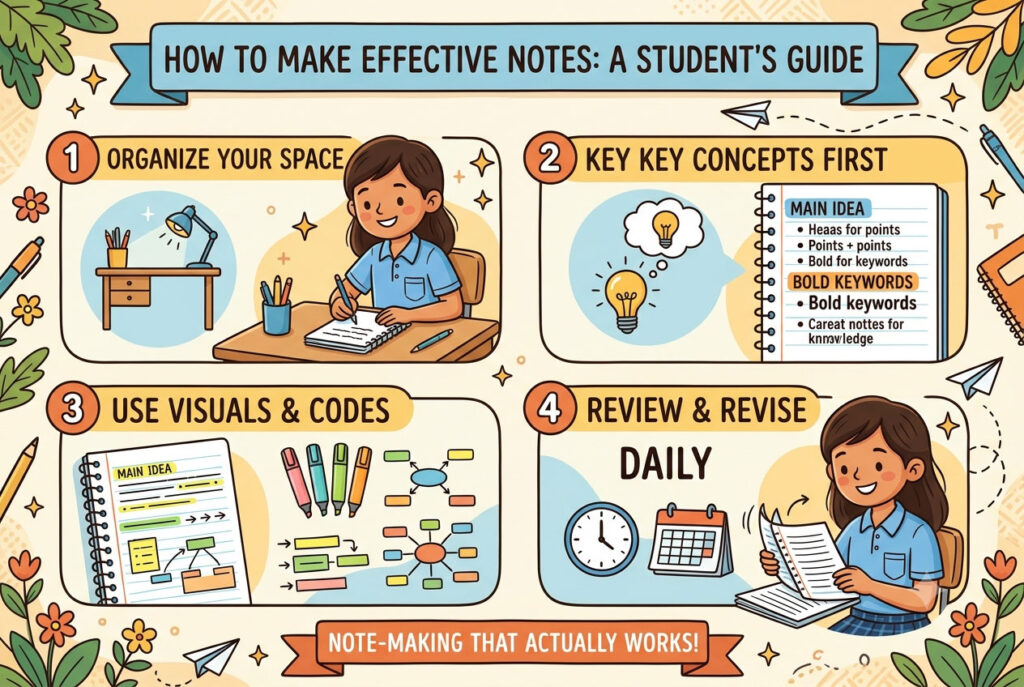
Most students take notes. Very few take notes that are actually useful later. There’s a big difference between copying everything off the board and making notes you can open two days before an exam and actually understand. This guide is about the second kind.
Whether you’re in Class 6 or Class 12, good note-making is one of the highest-return habits you can build — not because it sounds impressive, but because it cuts revision time dramatically and helps you remember things far longer.
Why Your Current Notes Might Not Be Working
If your notes look like a photocopy of the textbook — full sentences, everything written down, no structure — they’re probably not helping as much as they could. The problem isn’t effort; it’s format. When you write everything, your brain is transcribing, not thinking. When you make structured notes, your brain is processing — and that’s where the learning actually happens.
The goal of a good note is not to record everything. It’s to record the right things in a way that your future self can quickly understand.
Method 1: The Cornell Method (Best for Class Notes)
This is one of the most widely used note-making systems and works especially well for subjects with a lot of concepts — History, Science, Economics, English Literature.
How it works: Divide your page into three sections:
- A wide column on the right (about 70% of the page width) for your main notes during class
- A narrow column on the left for keywords and questions — fill this in after class
- A small strip at the bottom for a 2–3 line summary of the whole page
Why it works: The left column forces you to ask “what is the key idea here?” — which is exactly what exam questions ask. The bottom summary forces you to process the whole page before closing your notebook.
Best for: History dates and causes, Science concept explanations, any subject where teachers explain ideas verbally that don’t appear word-for-word in the textbook.
Method 2: Mind Maps (Best for Revision Notes)
A mind map starts with the main topic in the centre of a blank page, with branches spreading outward for sub-topics and smaller branches for specific points. It’s a visual structure, not a linear one.
How it works: Write the chapter name or main concept in the middle. Draw branches for each major sub-topic (e.g., for “Photosynthesis” — Reactants, Products, Process, Location, Factors Affecting). Add shorter branches for specific facts under each.
Why it works: Your brain stores memory in connected networks, not numbered lists. A mind map mirrors that structure. Many students find they can “see” the whole mind map in their head during an exam after spending time drawing it — something that’s almost impossible with pages of linear notes.
Best for: Science chapters with multiple interconnected concepts, Geography (rivers, climate, agriculture all connect), quick last-week revision of any chapter.
Method 3: The Outline Method (Best for Lengthy Chapters)
This is a hierarchical structure using headings, sub-points, and further details — similar to the structure of a textbook chapter, but much shorter.
How it works:
- Main heading (Chapter topic)
- Sub-heading (Major concept)
- Key point 1
- Key point 2
- Sub-heading (Next concept)
- Key point 1
- Sub-heading (Major concept)
Why it works: It’s fast to write, easy to scan, and forces you to identify what’s actually important versus what’s background detail. It also matches how CBSE exam answers are structured — main point, then supporting detail.
Best for: Long chapters in Social Science, Biology, and English Literature where there’s a clear hierarchy of information.
Method 4: The Two-Column Summary (Best for Formulas and Definitions)
This one is simple but extremely effective for subjects heavy on formulas, definitions, and terminology — Maths, Physics, Chemistry, Economics.
How it works: Draw a line down the middle of the page. On the left, write the formula name, term, or concept. On the right, write the formula, definition, or explanation. Cover the right side and test yourself.
Why it works: It turns your notes into a self-testing tool automatically. Instead of just reading and re-reading, you’re actively retrieving — which research consistently shows leads to far better long-term memory than passive re-reading.
Best for: Physics formulas, Chemistry reactions and equations, Economics definitions, Maths theorems.
General Rules That Apply to Any Method
Use your own words. If you write notes in the same words as the textbook, you’re copying, not understanding. Rewriting in your own words — even awkwardly — forces you to actually process what something means.
Use colour, but with a system. Highlighting everything in yellow means nothing stands out. A simple 3-colour system works well: one colour for main concepts, one for examples, one for things you’re unsure about and need to revisit.
Leave white space. Notes that fill every line on every page are hard to add to later. Leave a little room in the margin or between sections — you’ll often want to add something after a class discussion or teacher clarification.
Date every page. It sounds trivial, but knowing that these notes came from the class right before the unit test matters when you’re revising weeks later.
Review within 24 hours. The single most impactful note-making habit isn’t the format — it’s looking at your notes again within 24 hours of writing them. Even 10 minutes of review the same evening can double how much you actually retain.
The Difference Between Class Notes and Revision Notes
These are two different things and many students confuse them.
Class notes are what you make during class or while reading the chapter for the first time. They should be reasonably complete — capturing the main ideas, key examples, and anything the teacher emphasizes.
Revision notes are a condensed version you make from your class notes — usually one page per chapter, using a mind map or outline format, written in the last few weeks before exams. These are what you actually study from during crunch time.
If you only ever make one type, you’re either spending too long reading dense notes during revision, or you don’t have enough detail captured when you need to go back and check something.
A Note on Digital vs Handwritten
Typing notes is faster — but multiple studies on this topic have found that students who handwrite notes understand and retain the content better, even when the typed notes are more complete. The reason is the same as the “own words” rule: typing often becomes transcription; handwriting forces condensing.
Use digital notes for organizing, storing, and searching — especially for compiling revision notes from multiple sources. But for first-pass note-making in class or from a textbook, a pen and paper has a genuine advantage.
Final Thought
Good notes don’t have to be beautiful or complex. They have to be yours — meaning you understood what you were writing, not just copied it — and they have to be structured enough that you can use them later. Pick one method from this list and try it for two weeks in your hardest subject. The difference in how revision feels will be noticeable.
At SHEAT Public School, Varanasi, our teachers encourage structured note-making as part of how students engage with the curriculum — because the habit of processing information carefully, rather than just recording it, is one that serves students well beyond school.