

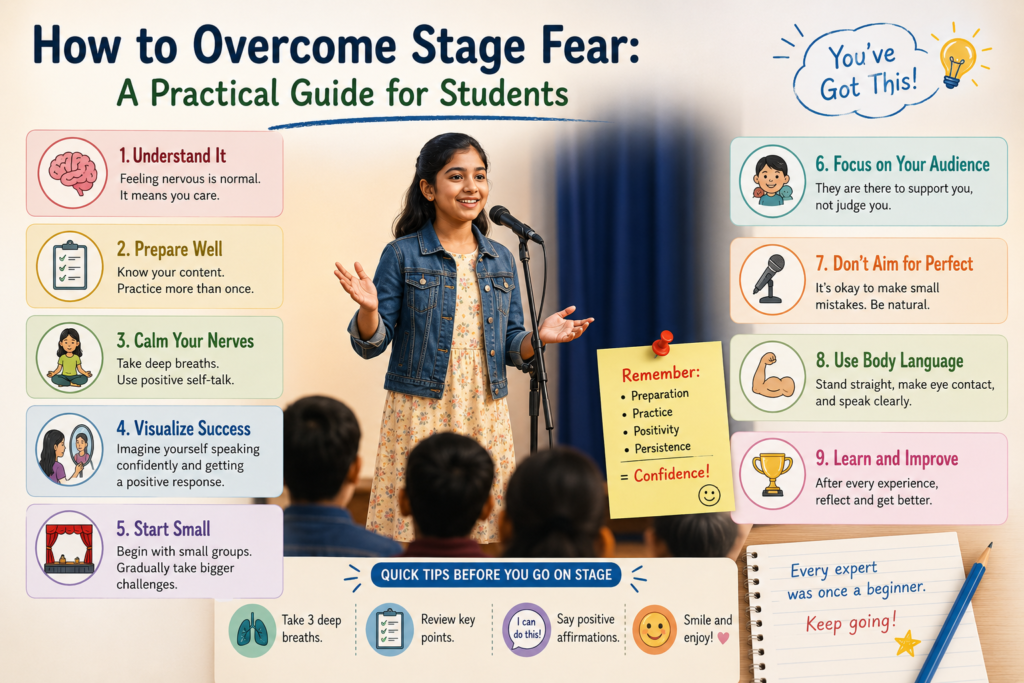
Your name gets called. You walk up to the stage for your speech, your annual day performance, or your class presentation — and suddenly your heart is racing, your hands feel cold, and your mind goes completely blank. If this sounds familiar, you’re not alone, and you’re definitely not “bad at this.” Stage fear is one of the most common fears in the world, affecting confident adults and accomplished performers just as much as students.
The good news: stage fear isn’t something you either have or don’t have forever. It’s a skill problem, not a personality problem — and like any skill, it gets better with the right approach.
First, Understand What’s Actually Happening
When you’re about to speak in front of people, your brain treats all those eyes on you as a kind of threat, and your body responds the way it would to any danger — faster heartbeat, quicker breathing, a rush of adrenaline. This is completely normal and happens to everyone, including people who look completely calm on stage. It doesn’t mean something is wrong with you; it means your body is doing exactly what bodies do under pressure. The goal isn’t to make the nervousness disappear completely — it’s to stop it from taking over.
Before the Day: How to Prepare
Know your content, don’t memorize it word-for-word. Memorizing a speech exactly often backfires — if you lose your place, you panic. Instead, learn the key points and the order they go in, like a roadmap, then speak naturally between them.
Practice out loud, not just in your head. Reading silently feels easy because your brain skips over the awkward parts. Saying it out loud — to a mirror, to a family member, or even recording yourself on your phone — shows you exactly where you stumble, so you can fix it before the real moment.
Practice in front of a small, low-pressure audience first. Try your speech in front of one or two family members before facing your whole class or the school stage. Small wins build real confidence faster than trying to be brave all at once.
Visit the space if you can. If you know where you’ll be standing — the classroom, the assembly stage, the auditorium — even picturing yourself standing there beforehand makes the real moment feel less unfamiliar.
Right Before You Go Up: Calming Your Body
Try slow breathing for 60 seconds. Breathe in for 4 counts, hold for 4, breathe out for 4, hold for 4. This is sometimes called box breathing, and it genuinely signals your nervous system to calm down — it’s not just a mental trick.
Relax your shoulders and unclench your hands. Nervousness often hides in tight shoulders and clenched fists without you noticing. Rolling your shoulders back and shaking out your hands for a few seconds physically interrupts the tension.
Use the “slow start” rule. Say your first two lines slower and calmer than feels natural. The first few seconds set the tone for your whole brain — starting slow tricks your body into following along calmly.
While You’re Speaking
Shift the spotlight in your mind. Instead of imagining everyone judging you, remind yourself that the audience mostly wants you to do well — most people watching aren’t thinking about your nerves at all; they’re thinking about your message.
If you lose your place, pause — don’t panic. A short pause feels like forever to you but barely registers to the audience. Take a breath, glance at your notes if you have them, and continue. Stopping briefly looks far more composed than rushing through in a panic.
Find one or two friendly faces. Looking at someone who’s smiling or nodding (a friend, a teacher you trust) can make the whole room feel less intimidating than staring at a sea of unfamiliar faces.
It’s okay to make small mistakes. A skipped word or a mixed-up sentence is rarely noticed by the audience the way it feels to you in the moment. Recovering calmly matters far more than getting every word perfect.
A Mindset Shift That Actually Helps
Even leaders and performers we admire today started out terrified of speaking in public. Many well-known public figures, including freedom fighters and successful entrepreneurs, struggled with stage fear early in life and got better only through repeated practice — not because the fear vanished overnight, but because they kept showing up anyway. Every time you go up despite feeling nervous, you’re doing the exact same thing they did.
Final Thought
Stage fear doesn’t disappear after one pep talk or one technique — it fades gradually, the more chances you give yourself to practice. At SHEAT Public School, Varanasi, our morning assemblies, debates, and annual day performances exist precisely for this reason: not to create pressure, but to give every student low-stakes, repeated chances to build this skill over time. The first time on stage is almost always the hardest. It gets easier from there.