
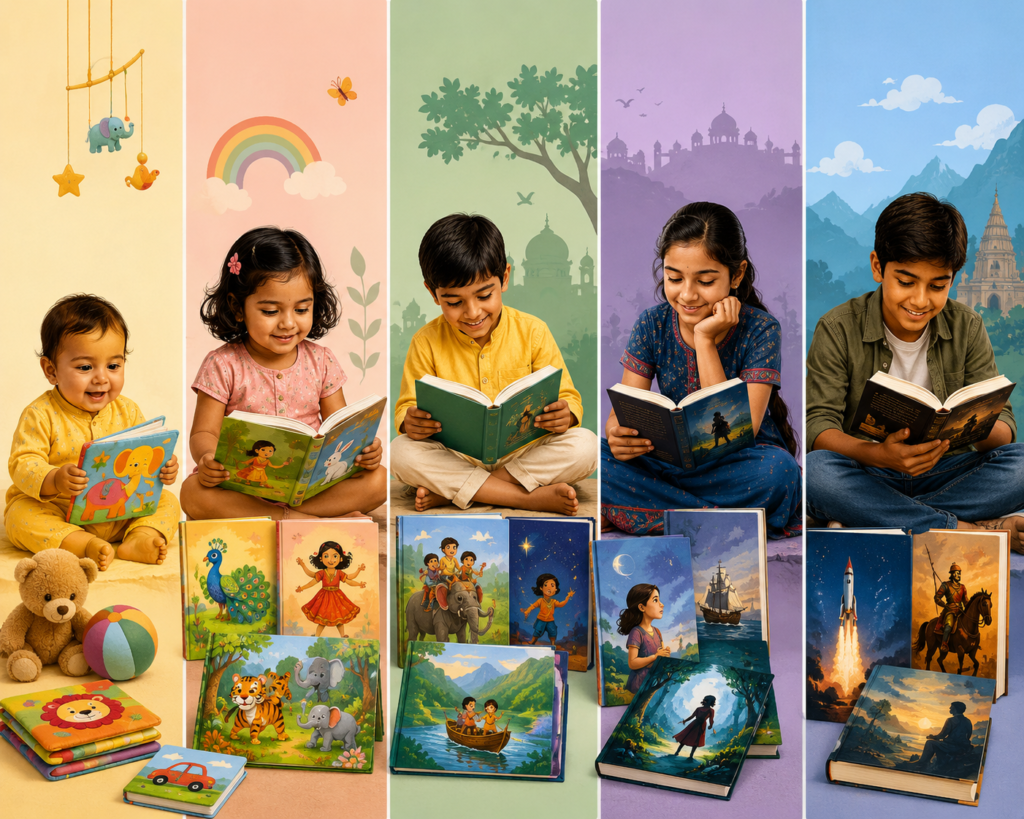
Every parent wants their child to love reading — but with so many books on the shelf, how do you pick the right one? The truth is, a book that’s perfect for a 5-year-old can completely bore a 9-year-old, and a book a 10-year-old loves might be too advanced for a 6-year-old just starting out.
At SHEAT Public School, Varanasi, we believe reading for pleasure builds something academics alone can’t: imagination, vocabulary, focus, and empathy — all skills that show up later in exam answers, classroom participation, and confidence. This guide breaks down the best books for kids by age, with real titles you can actually find, so you can pick books your child will genuinely enjoy rather than abandon after two pages.
Why Age-Appropriate Books Matter
A book that’s too simple feels boring. A book that’s too advanced feels frustrating. Either way, the child quietly decides “reading isn’t fun” — and that belief is hard to undo later. The right book at the right age does the opposite: it makes reading feel like a reward, not a chore.
Ages 3–5: Picture Books and Rhymes
At this stage, children aren’t reading words yet — they’re reading pictures, rhythm, and repetition. The goal is simple: make books feel warm, fun, and full of sound.
What works well:
- Panchatantra Stories (various illustrated editions) — short, moral-driven animal tales that have worked for Indian children for generations
- The Very Hungry Caterpillar by Eric Carle — simple counting and food words through a story even a 3-year-old can follow
- The Gruffalo by Julia Donaldson — rhyming text that kids start repeating from memory after a few reads
- Gajapati Kulapati by Ashok Rajagopalan — a much-loved Indian picture book with humor that works well as a read-aloud
Parent tip: At this age, you are doing most of the reading aloud. Point at pictures, ask “what do you think happens next?”, and don’t worry about finishing the book in one sitting.
Ages 6–8: Early Independent Readers
This is the bridge phase — children are sounding out words on their own but still need short sentences, big text, and pictures that support the story rather than replace it.
What works well:
- Tenali Raman Stories — witty, easy-to-follow tales that Indian kids relate to instantly, and short enough to finish one story per sitting
- Magic Tree House series by Mary Pope Osborne — adventure and light history in small, manageable chapters, great for building reading stamina
- The Blue Umbrella by Ruskin Bond — simple, warm storytelling rooted in Indian small-town life
- Vikram and Betal: Life Lessons for Our Times — a retelling of the classic Baital Pachisi, structured as short riddle-stories that hold attention well
Parent tip: This is also the age where reluctant readers can be lost if books feel like “homework.” Let your child pick titles themselves at this stage, even if you’d choose differently — ownership matters more than your preference.
Ages 8–10: Confident Readers Ready for Chapter Books
By now, most children can read longer chapters independently and start developing genre preferences — some lean toward adventure, others toward humor, others toward facts and information.
What works well:
- Diary of a Wimpy Kid by Jeff Kinney — extremely effective for reluctant readers thanks to humor and illustrated, diary-style pages that don’t feel like a wall of text
- Grandfather’s Private Zoo by Ruskin Bond — a gentle, nature-themed collection that builds a love for descriptive writing
- Vahana (8–13 age band) — explains the vahanas of Hindu gods and goddesses in accessible detail, blending mythology with general knowledge
- The Why-Why Girl by Mahasweta Devi — the story of a curious tribal girl who questions everything, a great pick for naturally inquisitive children
Parent tip: If your child finishes a book and immediately asks for “another one like this,” that’s the single best sign you’ve found their genre. Lean into it rather than redirecting them to “more serious” books too early.
Ages 10–12: Middle-Grade and the Start of Real Novels
This is where children can handle longer narratives, multiple characters, and themes with a bit more depth — without yet needing the heavier emotional weight of young-adult fiction.
What works well:
- Swami and Friends by R.K. Narayan — a classic, gentle introduction to character-driven Indian storytelling, best suited to confident readers in this range
- Gita for Children by Roopa Pai — a modern, accessible retelling that introduces ideas of duty, courage, and ethics without feeling like a lecture
- The Secret Diary of D by Deepa Agarwal — humor and relatable school-life situations, useful for kids who enjoy realistic stories over fantasy
- Amar Chitra Katha series — illustrated retellings of myths, history, and folklore; excellent for kids who enjoy a mix of story and visual storytelling
Parent tip: At this age, comprehension is no longer the bottleneck — attention span is. Shorter, well-paced books often work better than long, dense ones, even if a child is “advanced” for their age.
A Few Practical Tips for Building the Habit (Any Age)
- Set a fixed reading time, even just 15–20 minutes before bed. Consistency matters more than duration.
- Read together when possible — even older kids enjoy a parent reading a chapter aloud occasionally.
- Visit a library or bookstore physically. Letting a child browse and choose builds ownership that an online order doesn’t.
- Don’t force finishing a book. If a child genuinely dislikes a book after giving it a fair try, let them switch — forcing it teaches the opposite lesson of what you want.
- Mix Indian and international authors. Children benefit from seeing their own culture reflected in stories, alongside the wider variety international books offer.
Final Thought
Reading habits built between ages 3 and 12 quietly shape a child’s vocabulary, comprehension, and even how they approach exam questions years later — long after the specific books are forgotten. The goal isn’t to make every child a “bookworm,” but to make books feel like a source of enjoyment rather than another assignment.
At SHEAT Public School, Varanasi, we encourage this habit through our library and reading periods, alongside the academic curriculum — because the strongest readers in any classroom are usually the ones who started early, and started with books they genuinely enjoyed.