

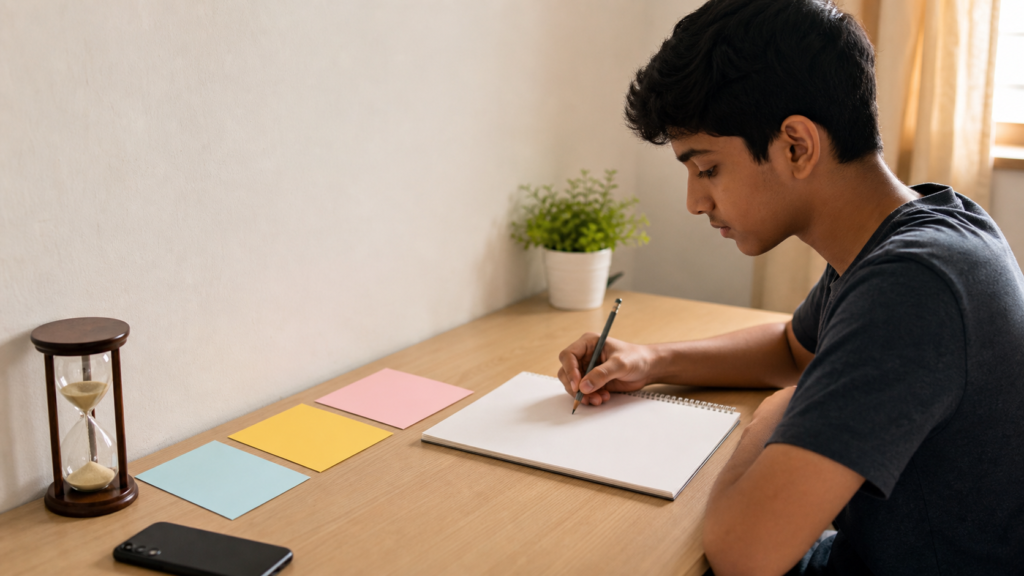
You open your book, then decide to sharpen a pencil. Next, you check one message, arrange the desk, and promise to start after five minutes. Suddenly, an hour is gone. This is procrastination: delaying an important task even when the delay may create stress later.
Students do not always procrastinate because they are lazy. A task may feel too large, boring, confusing, or frightening. The solution is not a long lecture. It is a smaller first step and a routine that makes starting easier. This guide explains how to stop procrastinating for students in simple, practical ways.
What Does Procrastination Look Like?
Procrastination can hide behind activities that appear useful. You may clean the desk instead of studying, make a perfect timetable but never follow it, or keep collecting information without writing the project.
Common signs include:
- waiting to “feel ready” before beginning;
- choosing easy tasks while an urgent task is ignored;
- starting only when the deadline becomes frightening;
- spending too much time planning or decorating;
- checking the phone during every small pause;
- saying, “I work better under pressure”; and
- avoiding a subject because you fear mistakes.
Why Do Students Delay Studying?
| Reason | Thought you may notice | Helpful response |
|---|---|---|
| Task feels too big | “I cannot finish all this.” | Choose one ten-minute step |
| Fear of mistakes | “My answer must be perfect.” | Make a rough first attempt |
| Unclear instructions | “I do not know where to begin.” | Write the exact question to ask |
| Boredom | “I will do it later.” | Use a short timer and a clear finish point |
| Distraction | “I will check only one video.” | Put the device outside reach |
| Low energy | “I am too tired to think.” | Rest, eat, or choose a better study time |
| No deadline plan | “There is plenty of time.” | Set an earlier personal deadline |
Notice the reason without insulting yourself. The correct solution depends on the cause.
The Five-Minute Start
Tell yourself, “I only need to work for five minutes.” Open the correct page, write the date and heading, and complete the smallest step. After five minutes, you may stop or continue.
This works because beginning is often harder than continuing. A small promise feels safe. Once the book is open and the first answer is started, the task is no longer unknown.
14 Ways Students Can Stop Procrastinating
1. Turn a Large Task into Actions
Do not write “study science.” Write “read pages 20–23,” “draw the water-cycle diagram,” and “answer questions 1–5.” Clear actions remove the need to decide what to do next.
2. Choose the First Tiny Step
The first step should take less than ten minutes. For an essay, it might be writing three ideas. For maths, it might be solving two examples. For a project, it might be choosing the topic.
3. Use a Start Time, Not Only a Deadline
“Project due Friday” tells you when to finish but not when to begin. Add “Start Tuesday at 5:00 PM.” A start time turns a future task into an appointment.
4. Remove the Phone Before Starting
Do not depend only on willpower. Put the phone in another room, give it to a parent for the focus period, or turn off alerts. If you need a device for learning, close entertainment apps and keep only the required page open.
5. Work in Short Focus Blocks
Start with 15 or 20 minutes of focused work and a five-minute break. Repeat if needed. A timer creates a visible end, so the task feels less endless.
6. Do the Important Task Before the Easy Extras
Answer the project questions before choosing colours for the cover. Learn the chapter before arranging notes. Decoration and organisation can become delay when the real work is avoided.
7. Make a Rough Version
Perfection can stop progress. Write a rough answer, sketch the diagram lightly, or make a simple outline. You can improve work that exists. You cannot improve a blank page.
8. Ask for Help Early
If you delay because the task is confusing, mark the exact point. Ask, “What should the introduction include?” or “Why is this formula used?” Asking early saves the panic of the last evening.
9. Use Visible Progress
Draw five boxes for five steps and tick each one. Move sticky notes from “To Do” to “Done.” Visible progress gives your mind proof that the task is becoming smaller.
10. Study at Your Better Time
Some students focus well soon after a snack and short rest. Others work better early in the morning. Place difficult work in your stronger time instead of saving it for when you are tired.
11. Prepare the Study Space
Keep the required book, notebook, and tools ready. Remove unrelated items. A simple setup reduces excuses to stand up repeatedly.
12. Plan a Small Reward
After completing a clear work block, enjoy a short activity such as music, a snack, drawing, or talking with family. The reward should come after the task and should have a clear end.
13. Use a Study Partner Carefully
Tell a reliable friend your goal, then check in after the work period. Study together only if both people can stay focused. A partner should support action, not become another distraction.
14. End by Preparing Tomorrow’s Start
Before closing your books, write the next step and leave the correct material ready. Tomorrow you can begin without deciding again.
A Seven-Day Anti-Procrastination Plan
| Day | Practice | Time |
|---|---|---|
| Day 1 | Notice one task you delay and write the reason | 5 minutes |
| Day 2 | Break one task into five small actions | 10 minutes |
| Day 3 | Put the phone away and complete one 20-minute block | 20 minutes |
| Day 4 | Start with a rough version instead of waiting for perfect work | 20 minutes |
| Day 5 | Ask one clear question about a confusing task | 10 minutes |
| Day 6 | Use checkboxes to complete three small steps | 30 minutes |
| Day 7 | Review what helped and plan next week | 10 minutes |
How to Start a Project Before the Last Day
Use backward planning. Begin with the due date and move back.
- Submission day: Carry and submit the finished project.
- One day before: Check spelling, pages, labels, and materials.
- Two days before: Finish the final section and pictures.
- Three days before: Write the main content.
- Four days before: Collect facts and make headings.
- Five days before: Choose the topic and understand instructions.
For more detail, use the school’s step-by-step project file guide.
What to Do When the Deadline Is Very Close
Do not waste the remaining time blaming yourself. Write every required part, circle the most important ones, and begin. Remove all distractions. Complete a clear and honest version instead of an unfinished perfect plan.
If you cannot finish, speak to the teacher honestly. Explain what is complete, what remains, and what you will do next. Do not copy another student’s work or invent an excuse.
How Parents Can Help Without Nagging
Repeated reminders can make both parent and child angry without making the task clearer. Try questions that lead to action:
- What is the first ten-minute step?
- What time will you begin?
- Which material do you need?
- Would you like me to keep the phone until the timer ends?
- What will “done” look like tonight?
Parents can help the child make a plan, but the child should complete the schoolwork. Praise starting on time and returning after a break, not only the final result.
Procrastination or a Bigger Difficulty?
Sometimes delay is connected to a learning gap, strong worry, low mood, poor sleep, or attention difficulty. A productivity tip may not solve the whole problem.
Speak with a teacher or appropriate professional when delay is frequent, causes serious distress, affects many parts of life, or continues despite support. Asking for help is responsible.
Build a Routine That Makes Starting Easy
A simple after-school routine might be:
- Return home and freshen up.
- Eat and rest for a set time.
- Check the homework and task list.
- Start one important 20-minute block.
- Take a short break.
- Continue or move to the next task.
- Pack the school bag.
The school’s study timetable guide and homework routine guide can help you build this structure.
Common Mistakes to Avoid
- Making a plan so detailed that there is no time to work
- Waiting for motivation before starting
- Using breaks without a timer
- Keeping the phone beside the book
- Calling yourself lazy after one difficult day
- Planning to complete a week’s work in one night
- Hiding confusion instead of asking a question
Frequently Asked Questions
What is the fastest way to stop procrastinating?
Choose a task, remove the phone, and work on the smallest step for five minutes. Starting creates progress faster than more planning.
Why do I procrastinate even when the work is important?
Importance can make a task feel frightening or too large. Break it into actions and allow a rough first attempt.
Is procrastination the same as laziness?
No. A student may want to succeed but delay because of fear, confusion, distraction, or poor planning. Find the cause and choose a matching solution.
How long should a student focus?
Start with 15–25 minutes and take a short break. Adjust the time for age, task, and attention. Quality matters more than a very long session.
What if I break my routine?
Restart at the next work period. One missed day does not erase progress. Make the next step smaller if the routine was too difficult.
Start Before You Feel Ready
You do not need perfect motivation, a perfect desk, or a perfect plan. You need one visible action. Open the page. Write the heading. Solve the first question. Work for five minutes.
At SHEAT Public School, students are encouraged to take responsibility for their learning while asking for support when needed. Every early start builds confidence. The next time your mind says “later,” answer with one small step now.