
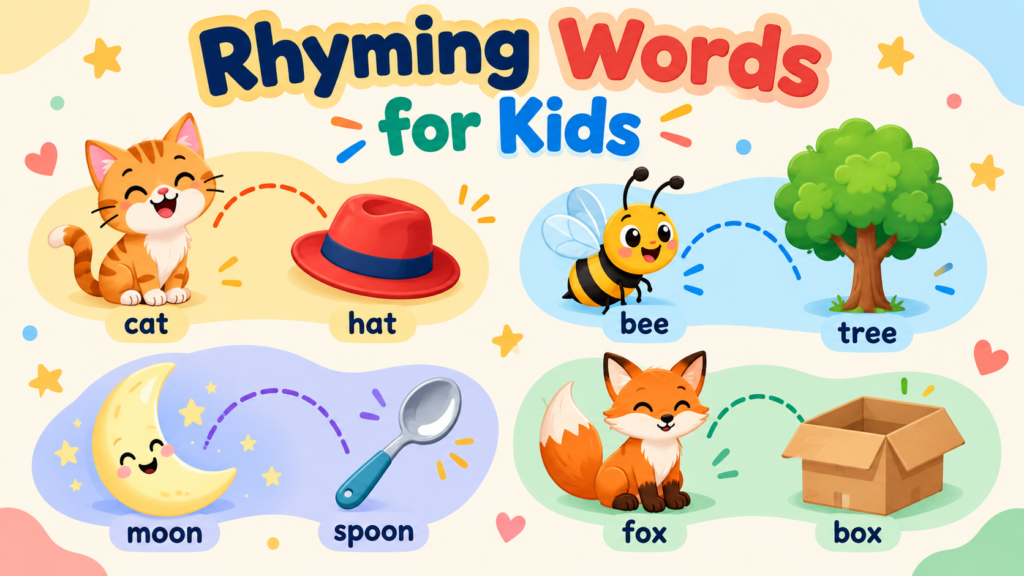
Quick answer: Rhyming words are words with the same or a very similar ending sound, such as cat–hat, play–day, and bright–night. This guide gives parents, teachers, and children 300+ easy rhyming words, word families, sentences, games, and a practice worksheet.
What Are Rhyming Words?
Rhyming words are two or more words whose sounds match from the final stressed vowel to the end. For young learners, the simplest explanation is: rhyming words sound alike at the end.
- cat / hat — both end with the /at/ sound
- cake / lake — both end with the /ake/ sound
- blue / shoe — the spellings differ, but the ending sound matches
Rhyme is about sound, not spelling. “Blue” and “shoe” rhyme, while “love” and “move” do not. Encourage children to say each word aloud instead of judging only by the letters.
Rhyming Words at a Glance
| Word | Easy rhyming words | Example |
|---|---|---|
| Cat | bat, fat, hat, mat, pat, rat, sat | The cat wore a hat. |
| Dog | bog, fog, frog, hog, jog, log | The dog jumped over a log. |
| Sun | bun, fun, run, spun, won | We run and have fun in the sun. |
| Day | bay, clay, hay, may, pay, play, say, stay, way | We play outside every day. |
| Light | bright, flight, kite, might, night, right, sight, tight | The kite looked bright in the light. |
| Tree | bee, free, key, knee, sea, see, three | I see a bee near the tree. |
| Book | cook, hook, look, nook, shook, took | Look at the cook with a book. |
| Moon | June, noon, soon, spoon, tune | We sang a tune under the moon. |
300+ Rhyming Words for Kids by Word Family
Word families help children notice reusable sound patterns. Begin with short, familiar words and introduce only one or two families at a time.
Short-a rhyming word families
| Family | Rhyming words |
|---|---|
| -at | bat, cat, chat, fat, flat, hat, mat, pat, rat, sat, splat, that |
| -an | ban, can, fan, man, pan, plan, ran, scan, tan, van |
| -ap | cap, clap, flap, gap, lap, map, nap, rap, sap, slap, snap, tap, trap |
| -ad | bad, dad, glad, had, lad, mad, pad, sad |
| -ack | back, black, crack, jack, pack, rack, sack, snack, stack, track |
| -ash | bash, cash, clash, crash, dash, flash, mash, rash, splash, trash |
Short-e rhyming word families
| Family | Rhyming words |
|---|---|
| -ed | bed, bled, fed, fled, led, red, shed, sled, sped |
| -en | den, hen, men, pen, ten, then, when, wren |
| -et | bet, get, jet, let, met, net, pet, set, wet, yet |
| -ell | bell, cell, fell, shell, smell, spell, tell, well, yell |
Short-i rhyming word families
| Family | Rhyming words |
|---|---|
| -ig | big, dig, fig, jig, pig, rig, twig, wig |
| -in | bin, chin, fin, grin, pin, skin, spin, thin, tin, twin, win |
| -ip | chip, clip, dip, drip, flip, grip, hip, lip, ship, sip, skip, slip, trip, zip |
| -it | bit, fit, hit, kit, knit, lit, pit, quit, sit, split |
| -ick | brick, chick, click, kick, lick, pick, quick, sick, stick, thick, trick |
Short-o rhyming word families
| Family | Rhyming words |
|---|---|
| -og | bog, clog, dog, fog, frog, hog, jog, log, smog |
| -op | chop, crop, drop, flop, hop, mop, pop, shop, stop, top |
| -ot | cot, dot, got, hot, lot, not, pot, plot, spot |
| -ock | block, clock, dock, flock, lock, rock, shock, sock |
Short-u rhyming word families
| Family | Rhyming words |
|---|---|
| -ug | bug, dug, hug, jug, mug, plug, rug, shrug, slug, snug, tug |
| -un | bun, fun, run, shun, spun, stun, sun, won |
| -ump | bump, clump, dump, grump, hump, jump, lump, plump, pump, stump |
| -uck | buck, duck, luck, pluck, stuck, truck |
Long-vowel and common sound families
| Family | Rhyming words |
|---|---|
| -ake | ache, bake, brake, cake, fake, flake, lake, make, rake, shake, snake, stake, take, wake |
| -ay | bay, clay, day, grey, hay, lay, may, pay, play, pray, ray, say, stay, sway, tray, way |
| -ee | bee, free, glee, key, knee, sea, see, three, tree |
| -eep | cheap, creep, deep, heap, keep, leap, peep, sheep, sleep, steep, sweep, weep |
| -ight | bright, fight, flight, light, might, night, right, sight, tight |
| -ide | bride, glide, hide, pride, ride, side, slide, stride, tide, wide |
| -ine | dine, fine, line, mine, nine, pine, shine, sign, spine, vine, wine |
| -oke | broke, choke, cloak, joke, poke, smoke, spoke, stroke, woke |
| -one | bone, cone, drone, grown, known, loan, phone, stone, throne, tone |
| -oon | balloon, croon, June, moon, noon, soon, spoon, tune |
| -ool | cool, drool, fool, pool, school, stool, tool |
| -air | bear, care, chair, dare, fair, flare, hair, pair, pear, share, stair, wear |
| -all | ball, call, fall, hall, mall, small, stall, tall, wall |
| -ar | car, far, jar, scar, star |
| -ark | bark, dark, lark, mark, park, shark, spark |
| -ound | bound, found, ground, hound, mound, round, sound |
| -ing | bring, cling, king, ring, sing, spring, sting, string, swing, thing, wing |
| -ow | blow, crow, flow, glow, grow, know, low, show, slow, snow, throw |
| -ue / -oo | blue, clue, crew, dew, flew, glue, grew, new, shoe, stew, through, true, you |
Pronunciation note: English accents vary. A pair may rhyme in one accent but not another. Teach the pronunciation children hear in their classroom and community, and check unfamiliar words in a learner’s dictionary with audio.
Easy Rhyming Pairs for Nursery and Kindergarten
Start with pairs before asking a child to produce a long rhyme chain:
- cat–hat
- bat–mat
- dog–log
- frog–fog
- sun–fun
- run–bun
- pen–hen
- bed–red
- pig–wig
- sit–fit
- hop–mop
- top–stop
- cake–lake
- day–play
- bee–tree
- moon–spoon
- book–look
- chair–bear
Rhyming Words by Class Level
Nursery and preschool: listen and match
Use familiar one-syllable pairs such as cat–hat, dog–log, sun–fun, and bee–tree. Say the words, show pictures, and let children point to the matching rhyme. At this stage, listening matters more than spelling.
Kindergarten and Class 1: build rhyme families
Introduce simple CVC families such as -at, -an, -ig, -in, -og, and -un. Children can sort cards, complete spoken sentences, and write two or three words from each family.
Classes 2 and 3: compare sound and spelling
Explore spellings that produce the same sound: blue–shoe, sea–tree, night–kite, and fair–bear. This helps children learn that English spelling and pronunciation do not always match perfectly.
Classes 4 and 5: use rhyme creatively
Children can write couplets, identify rhyme schemes, distinguish perfect and near rhymes, and choose words that fit both meaning and rhythm.
Types of Rhymes With Examples
Perfect rhyme
The ending sounds match closely: cat–hat, play–day, bright–night.
Near rhyme
The sounds are similar but not exact. Near rhymes appear more often in songs and advanced poetry than in beginner phonics.
Eye rhyme
The endings look alike but sound different: love–move, cough–though. These are useful examples of words that do not truly rhyme.
End rhyme and internal rhyme
An end rhyme appears at the ends of lines. An internal rhyme occurs within one line. “The quick little fox jumped over the box” contains an internal fox–box rhyme.
20 Rhyming Sentences for Kids
- The cat sat quietly on the mat.
- A small frog rested on a log.
- We run in the sun just for fun.
- The hen found a pen near the den.
- The bright kite flew out of sight.
- A tiny mouse ran through the house.
- Please look inside the blue book.
- The king likes to sing in spring.
- The bear sat carefully on the chair.
- We will bake a cake beside the lake.
- A sheep fell asleep in a heap.
- The duck had good luck near the truck.
- The star looked far beyond the car.
- The bee flew free around the tree.
- I found a round stone on the ground.
- The snail left a trail beside the rail.
- The clown wore a crown in the town.
- A fox hid inside a cardboard box.
- At noon, we sang a tune to the moon.
- The tall ball rolled down the hall.
10 Fun Rhyming-Word Activities
1. Rhyme basket
Put picture cards or safe household objects in a basket. A child picks one and finds a card that rhymes with it.
2. Clap if it rhymes
Say pairs such as cat–hat, dog–sun, and cake–lake. Children clap for a rhyme and keep their hands still for a non-rhyme.
3. Odd word out
Give three words—such as log, frog, sun—and ask which one does not belong.
4. Finish my rhyme
Pause before the final word: “The cat is sitting on the ___.” Offer a picture clue if needed.
5. Rhyme-chain challenge
Begin with “day”. Take turns adding play, say, way, stay, and so on. Stop when a word repeats.
6. Rhyming memory cards
Place picture cards face down. Children turn over two cards and keep the pair when the names rhyme.
7. Rhyme hunt
Choose a word and look around the classroom or home for a rhyme. A “chair” may lead to hair, bear, or pair.
8. Rhyme sorting
Mix cards from three families, such as -at, -og, and -un. Children sort them into labelled hoops or boxes.
9. Silly rhyme story
Create a playful two-line story: “A goat wore a coat / and sailed in a boat.” Nonsense ideas keep children willing to experiment.
10. Make a family rhyme book
Give each page one sound family. Add words, drawings, and a sentence throughout the week.
How to Teach Rhyming Words Step by Step
- Hear: Read songs, poems, and short rhyming stories aloud.
- Recognise: Ask whether two spoken words rhyme.
- Match: Pair objects or pictures with rhyming names.
- Complete: Let the child supply one missing word.
- Generate: Ask for another word that rhymes.
- Read: Connect sounds with written word families.
- Write: Create sentences, couplets, and short poems.
Keep practice short—five to ten playful minutes is often more productive than a long memorisation session.
Common Mistakes to Avoid
- Teaching by spelling alone: Children must hear the words because rhyme is a sound relationship.
- Mixing accents without explanation: Model a clear pronunciation and acknowledge genuine accent differences.
- Using too many unfamiliar words: A shorter list of meaningful words is more useful than words a child cannot understand.
- Rejecting invented words: “Zat” shows that the child has heard the -at pattern. Ask whether it is a real word after celebrating the sound match.
- Moving to writing too early: Recognition normally comes before production, reading, and spelling.
- Trusting matching spelling: Love–move and cough–though show why children should say words aloud.
Mini Rhyming-Words Worksheet
A. Circle the word that rhymes
- cat: sun / hat / dog
- tree: bee / car / book
- light: pen / night / ball
- cake: lake / moon / fish
- frog: star / log / chair
B. Find the odd word
- bat, mat, run
- dog, fog, sun
- play, stay, book
- light, night, cake
- blue, shoe, tree
C. Complete each sentence
- The cat sat on the ______.
- I saw a frog beside a ______.
- We play outside every ______.
- The sheep went to ______.
- I can see a bee near the ______.
Answer key: A: hat, bee, night, lake, log. B: run, sun, book, cake, tree. C: Suggested answers—mat, log, day, sleep, tree.
How Parents Can Practise Rhyming at Home
Use ordinary routines rather than turning every activity into a lesson. Find rhymes while getting dressed, travelling, tidying toys, or reading before bed. Pause at predictable words in a familiar rhyme and allow thinking time. Praise careful listening, not just correct answers.
If a child finds rhyme difficult, return to matching two spoken words and use pictures. Avoid comparing children. Consult the child’s teacher if difficulty with sounds continues alongside broader speech, hearing, or early-reading concerns.
Frequently Asked Questions
What are rhyming words?
Rhyming words have matching or very similar sounds at the end, such as cat–hat, day–play, and blue–shoe.
What are 10 easy rhyming pairs?
Cat–hat, dog–log, sun–fun, pen–hen, bed–red, pig–wig, hop–mop, cake–lake, bee–tree, and moon–spoon.
Do rhyming words need the same spelling?
No. Rhyme depends on pronunciation. “Blue” and “shoe” rhyme even though their spellings differ.
What are the easiest word families for beginners?
The -at, -an, -ap, -ig, -in, -og, -op, and -un families contain many familiar, decodable words.
At what age can children learn rhyming words?
Children can enjoy spoken rhymes from their earliest years. Simple rhyme matching is commonly introduced during preschool, while reading and writing word families develop as formal literacy instruction begins. Readiness varies.
Why can my child recognise a rhyme but not think of one?
Recognition is easier than generation and usually develops first. Continue matching games and sentence-completion prompts.
Are word families and rhyming words the same?
They overlap, but are not identical. Word families often share spelling and sound, whereas rhyming words only need matching sounds. “Blue” and “shoe” rhyme but do not share the same spelling family.
What words look as if they rhyme but do not?
Love–move, cough–though, and food–good have similar-looking endings but different pronunciations.
How often should children practise?
Five to ten minutes several times a week, combined with regular reading aloud, supports enjoyable and consistent practice.
Final Takeaway
Rhyming words help children listen closely, notice sound patterns, expand vocabulary, and approach reading with confidence. The most effective sequence is simple: hear the rhyme, recognise it, match it, say it, read it, and finally write it. Use the lists as a resource—not a memorisation target—and keep learning playful.
At SHEAT Public School, Varanasi, language learning is supported through age-appropriate practice, reading, conversation, and creative classroom activities. Parents can reinforce the same skills at home with stories, songs, and the short games in this guide.